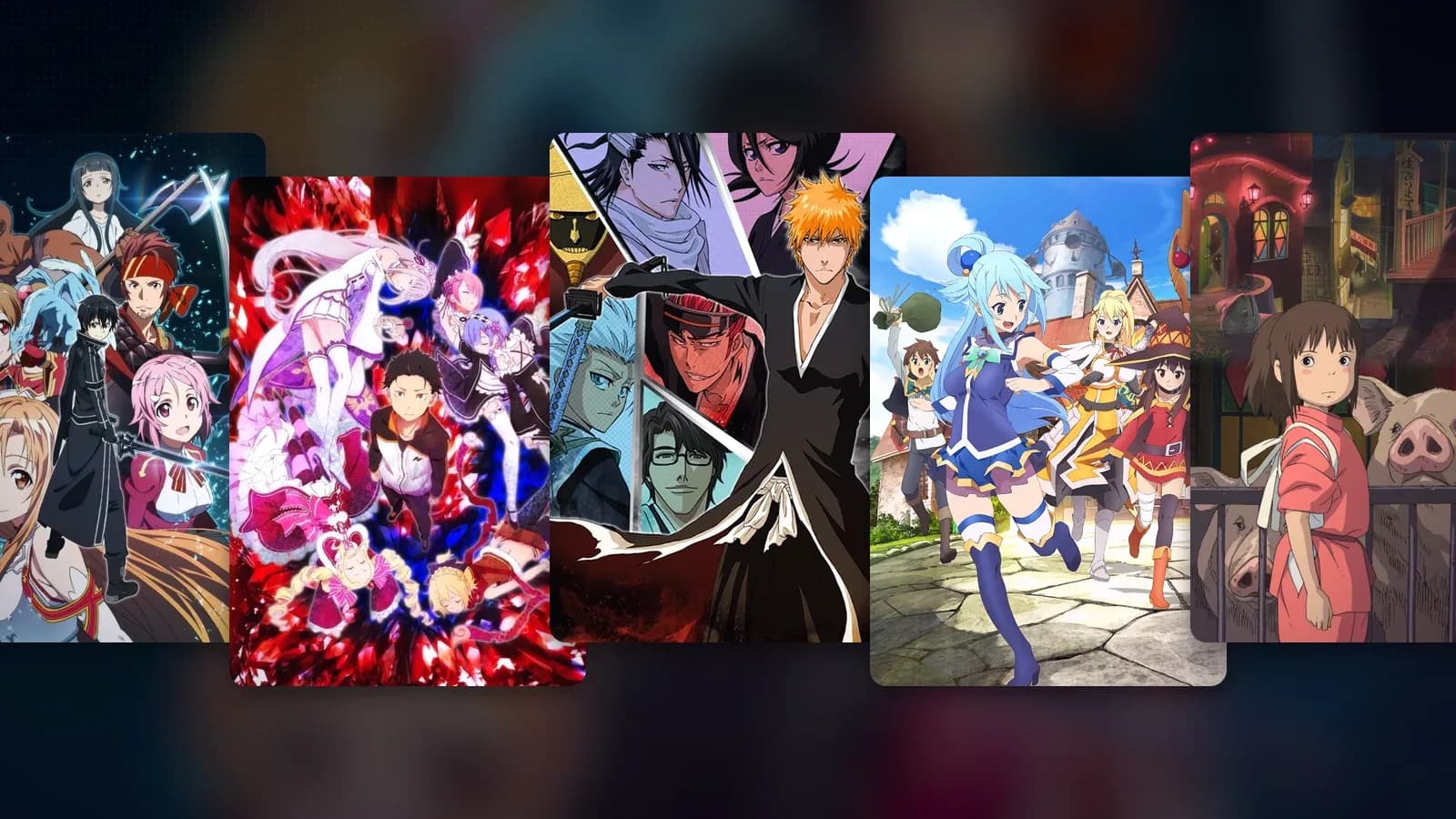
The best isekai anime with an overpowered main character (OP MC) often comes down to one question: what kind of power fantasy are you looking for? The appeal of the genre isn't just watching someone win easily, but seeing how their immense power reshapes a new world and its rules. From unbeatable gods and strategic masterminds to prodigies who earn their strength, the OP protagonist is a core pillar of modern isekai.
This list breaks down the top series by the type of power the main character wields. Whether you want to see a hero build a nation from scratch, outsmart their foes in high-stakes games, or simply dominate with absolute magical force, you’ll find a recommendation that fits your preference. We've selected the essential titles where the protagonist's overwhelming power is the central engine of the story.
Each character offers a different flavor of dominance. Some arrive fully formed with game-breaking abilities, while others grow into their power at a dizzying pace. Understanding these archetypes is key to finding the perfect show to watch next.
Key takeaways
- Overpowered (OP) main characters in isekai are defined by more than just strength; their power can be intellectual, strategic, or developmental.
- Overlord's Ainz Ooal Gown represents the 'villain protagonist' whose power is absolute from the very beginning.
- That Time I Got Reincarnated as a Slime's Rimuru Tempest showcases exponential growth, using power for nation-building.
- Mushoku Tensei's Rudeus Greyrat is a prodigy whose immense magical talent is cultivated from infancy, but he still faces real challenges.
- No Game, No Life and Sword Art Online feature protagonists whose power comes from mastering the rules of their game-like worlds.
- The Rising of the Shield Hero provides an unconventional OP MC whose strength lies in unparalleled defense and tactical creativity.
What Makes an Isekai Protagonist Overpowered?
An overpowered main character's defining trait is their ability to fundamentally disrupt the power balance of their new world. This isn't always about throwing the biggest fireball. Their power can manifest as strategic genius that no one can predict, a unique skill that bypasses conventional limits, or political authority that commands absolute loyalty.
These characters generally fall into two camps. The first type is overpowered from the moment they arrive, often because they’ve been transported with max-level stats from a game or granted a divine, world-breaking ability. The narrative tension for these characters isn't about survival, but about how they choose to use their power and the consequences of their actions.
The second type grows into their power, but at a rate that leaves everyone else in the dust. They might be a reincarnated prodigy with an adult mind or someone with a unique skill that scales exponentially. While they face initial challenges, they quickly surpass their peers and teachers, establishing a new ceiling for what's considered possible. This list focuses on protagonists from both categories whose overwhelming strength is the story's main attraction.
Overlord: The Unbeatable Villain Protagonist
Overlord presents one of the purest examples of an isekai with an OP MC. The story begins at the end of a popular virtual reality game, Yggdrasil. The protagonist, Momonga, decides to stay logged in until the servers shut down, but instead finds himself transported to a new reality, still inhabiting his avatar: a max-level skeletal lich, Ainz Ooal Gown.
From the very first episode, Ainz's power is absolute. As a top-tier magic caster with access to world-breaking spells and a legion of fanatically loyal, high-level NPC guardians who have become sentient, he is effectively a god. No single person or even nation in the new world stands a chance against him or the Great Tomb of Nazarick. The power gap is so immense that conflict is less a battle and more a foregone conclusion.
The series' core appeal and tension derive from this premise. The story isn't about whether Ainz can win, but how he navigates a world he doesn't understand while maintaining the persona of an infallible supreme being for his followers. It's a fascinating character study on the loneliness of absolute power and the creeping moral ambiguity that comes with being an unstoppable force of conquest.
That Time I Got Reincarnated as a Slime: The Nation-Builder
That Time I Got Reincarnated as a Slime (Tensei Shitara Slime Datta Ken) takes a seemingly weak concept and turns it into a masterclass in power scaling. After being killed in modern-day Japan, 37-year-old Satoru Mikami is reborn in a fantasy world as a low-level slime monster. This humble beginning is immediately subverted by his unique skill, "Predator."
This ability allows him, now named Rimuru Tempest, to absorb anything he consumes and analyze its properties and skills. This creates an exponential power curve; the more he consumes, the more powerful and versatile he becomes. He quickly evolves from a simple slime to a being capable of mimicking powerful monsters, mastering complex magic, and eventually becoming a Demon Lord.
What makes Rimuru a standout OP MC is what he does with his power. Instead of focusing solely on combat, he uses his modern-day knowledge and ever-growing abilities to build a progressive and inclusive nation for monsters. His story is one of diplomacy, infrastructure, and community building, where his strength is the foundation that allows his peaceful society to flourish. It’s a refreshingly optimistic take on the power fantasy, where being OP is a tool for creation, not just destruction.
Mushoku Tensei: Jobless Reincarnation: The Prodigy
Mushoku Tensei: Jobless Reincarnation (Mushoku Tensei: Isekai Ittara Honki Dasu) offers a more grounded and character-driven take on the OP protagonist. It follows a 34-year-old shut-in who, after a pathetic death, is reincarnated as a baby named Rudeus Greyrat in a world of sword and sorcery. Crucially, he retains the memories and adult consciousness of his former life.
Determined not to repeat his past mistakes, he dedicates himself to living this new life to the fullest. He begins practicing magic as an infant, and the combination of his adult mind, years of relentless practice, and natural aptitude turns him into a magical prodigy. By childhood, he can perform complex, silent spellcasting that astounds even elite mages. His growth is meteoric, quickly establishing him as a generational talent.
However, Rudeus is far from invincible. He faces genuine emotional trauma, physical danger, and situations where his magic isn't a simple solution. His power is earned through dedication, and the story never lets him forget that strength alone doesn't solve all problems. This makes his journey compelling, as his power feels like a believable part of his development rather than a simple plot device.
No Game, No Life: The Strategic Masterminds
In No Game, No Life, power isn't measured in physical strength or magical energy, but in pure intellect. The protagonists are Sora and Shiro, a pair of shut-in step-siblings who are legendary as the undefeated online gaming duo "Blank." Bored with the real world, they are summoned to Disboard, a fantasy realm where a god has forbidden all violence and all conflicts are resolved through games.
In this world, Sora and Shiro are supremely overpowered. Their combined genius for strategy, logic, probability, and human psychology makes them unbeatable. They can analyze the rules of any game, no matter how complex or unfair, and devise a flawless path to victory. Their ability to predict their opponents' moves and exploit loopholes in the system is their game-breaking skill.
Their journey sees them go from homeless vagrants to challenging entire kingdoms for control. The excitement comes from watching them dissect seemingly impossible games and turn the tables on their powerful, magically-gifted opponents using nothing but their wits. It's the ultimate power fantasy for anyone who believes brains will always triumph over brawn.
Sword Art Online: The Trapped Gamer
Sword Art Online is one of the foundational series of the modern isekai boom, trapping thousands of players inside a deadly virtual reality MMORPG where game-death means real-life death. The protagonist, Kirito, quickly establishes himself as one of the most powerful players, but his strength isn't a gift from a god—it's a product of knowledge and skill.
As a former beta tester for the game, Kirito enters Aincrad with a crucial head start. He knows the game's early zones, mechanics, and effective leveling strategies. This foreknowledge, combined with his natural talent for the game and preference for high-risk solo play, allows him to gain levels and resources far faster than the average player. He becomes a "beater" (beta tester-cheater), operating on a level most players can't comprehend.
His overpowered status is contextual to the world he's in. He's not a god, but a highly skilled player with an information advantage. This leads to him acquiring unique skills, like Dual Wielding, that no one else has. While other players must band together in guilds to survive, Kirito becomes a frontline force capable of taking on floor bosses and clearing the game's deadliest content, making him a legend within the world of SAO.
The Rising of the Shield Hero: The Unconventional Power-Up
The Rising of the Shield Hero (Tate no Yuusha no Nariagari) deconstructs the OP MC trope before building it back up in a unique way. Naofumi Iwatani is summoned to a fantasy world as one of four Cardinal Heroes, but he's handed the Legendary Shield—a weapon with no direct offensive capability. Labeled the weakest hero, he is quickly betrayed, framed for a crime, and ostracized by the entire kingdom.
This forces Naofumi to find unconventional paths to power. His strength doesn't come from attack stats, but from the near-limitless potential of his shield. It can absorb materials from defeated monsters and the environment to unlock new forms, each with unique defensive, supportive, and even counter-attacking abilities. He innovates, using tactics and party synergy where other heroes rely on brute force.
While he can't one-shot his enemies, Naofumi becomes overpowered in a different sense: he is practically unkillable. His unparalleled defense and tactical creativity allow him and his party to survive encounters that would wipe out anyone else. He proves that being OP isn't just about having the highest damage output; it can mean being the unbreachable wall that your enemies break themselves against.
Which Type of OP MC Is Right for You?
Choosing the best isekai anime with an OP MC depends entirely on the kind of dominance you enjoy watching. Each of these series offers a distinct take on what it means to be the most powerful person in the room.
If you want to see a character grapple with the moral complexities of absolute, villainous power, Overlord is the clear choice. For a more optimistic story about using overwhelming strength to build a better world, That Time I Got Reincarnated as a Slime delivers a satisfying tale of creation and diplomacy. If you prefer a hero who feels like they've earned their incredible talent through grit and genius, Mushoku Tensei: Jobless Reincarnation provides a deep, character-focused journey.
For those who love intellectual battles, No Game, No Life's strategic showdowns are unmatched. Meanwhile, Sword Art Online offers a classic take on game mastery, and The Rising of the Shield Hero champions the power of unbreakable defense and tactical ingenuity. The table below summarizes what makes each protagonist tick, helping you find your next favorite OP hero.
| Anime Title | Protagonist(s) | Source of Power | Primary Use of Power |
|---|---|---|---|
| Overlord | Ainz Ooal Gown (Momonga) | Max-Level Game Avatar | World Conquest |
| That Time I Got Reincarnated as a Slime | Rimuru Tempest (Satoru Mikami) | Reincarnation Perk (Predator Skill) | Nation-Building & Diplomacy |
| Mushoku Tensei: Jobless Reincarnation | Rudeus Greyrat | Reincarnated Prodigy & Hard Work | Adventure & Self-Improvement |
| No Game, No Life | Sora & Shiro (Blank) | Super-Genius Intellect | Winning High-Stakes Games |
| Sword Art Online | Kirito (Kazuto Kirigaya) | Beta Test Knowledge & Player Skill | Survival & Game Progression |
| The Rising of the Shield Hero | Naofumi Iwatani | Unconventional Weapon Growth | Defense & Party Leadership |
Frequently asked questions
What is an isekai anime with an OP MC?
An isekai anime with an OP MC features a protagonist who is transported to another world and possesses power that far exceeds the native inhabitants. This power can be magical, physical, intellectual, or based on a unique skill that breaks the world's rules.
Is Kirito from Sword Art Online considered an OP MC?
Yes, Kirito is widely considered an OP MC within the context of his world. His status as a beta tester gave him a significant knowledge advantage, which, combined with his natural skill, allowed him to level up faster and acquire unique abilities that set him far above other players.
What is the difference between an OP MC and a regular protagonist?
A regular protagonist typically grows stronger by overcoming challenges that are scaled to their level. An OP MC, by contrast, either starts with overwhelming power or acquires it so rapidly that few, if any, challenges pose a genuine threat to them. The story often focuses on the consequences of their power rather than their struggle for survival.
Are there any isekai where the MC is a villain?
Yes, Overlord is a prominent example of an isekai with a villain protagonist. The main character, Ainz Ooal Gown, is an undead lich who uses his immense power to conquer the new world, often through ruthless and morally questionable means.
Which OP MC is the strongest?
Defining the 'strongest' is difficult as their powers are not directly comparable. Ainz from Overlord possesses absolute magical power from the start, making him a top contender for raw destructive force. However, Rimuru from Slime has nearly infinite potential for growth, while Sora and Shiro from No Game, No Life are unbeatable in a world governed by games.
Keep reading on WeebMeta
- 7 Best Anime Like Mushoku Tensei: Jobless Reincarnation
- Mushoku Tensei Ending Explained: Anime vs. Light Novel