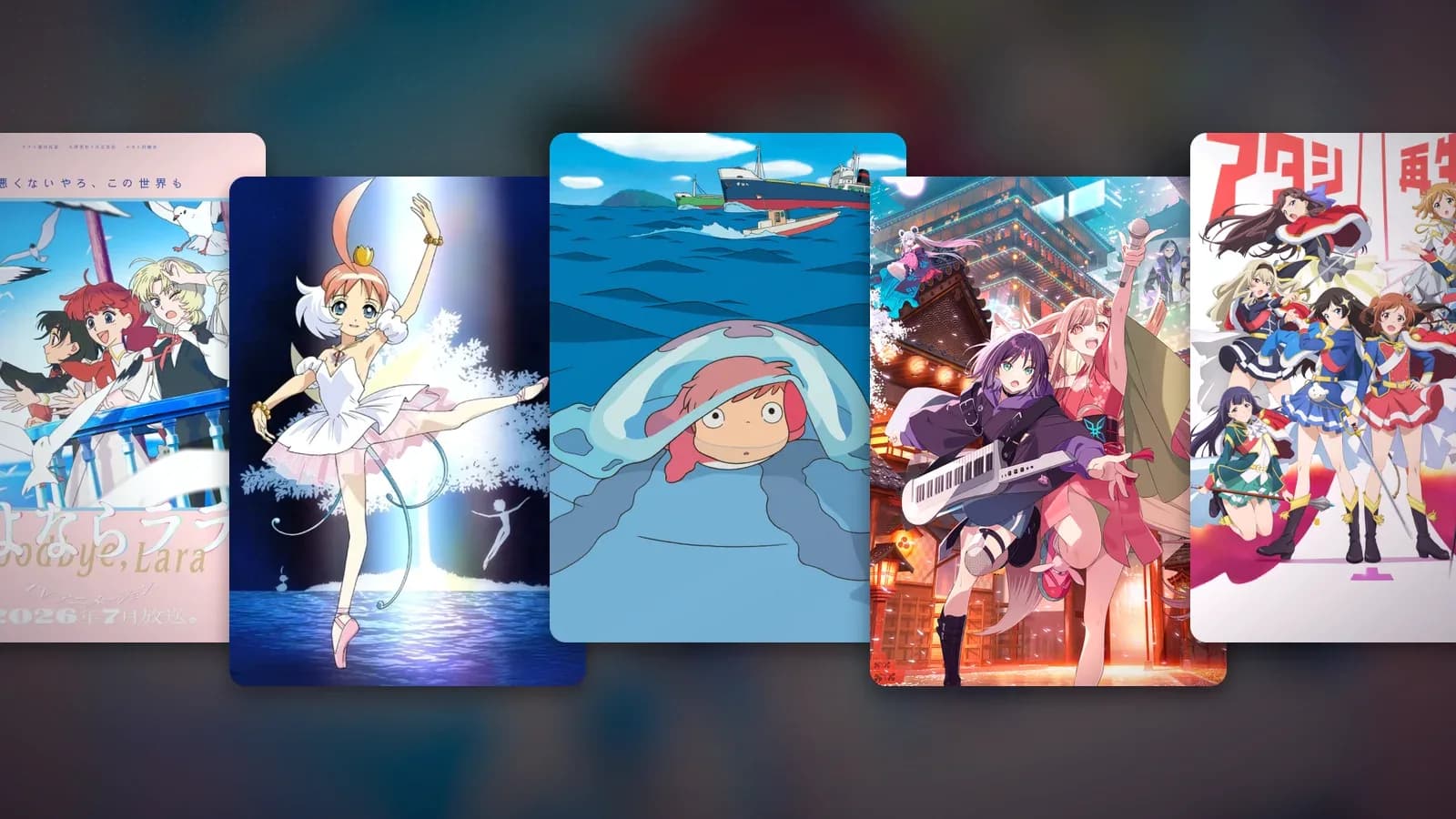
If you are looking for an anime like Goodbye, Lara, you are likely searching for a story that blends modern drama with classic fairy tale magic. The Kinema Citrus original series is an urban fantasy take on Hans Christian Andersen's "The Little Mermaid," following a resurrected mermaid princess on a final quest for true love in modern-day Japan.
The following recommendations share key ingredients: a dramatic reimagining of a known story, a determined female protagonist caught between two worlds, bittersweet interspecies romance, and the weight of curses or destiny. Lara's journey is defined by her struggle against a magical pact and her coming-of-age in a world not her own, creating a mix of fantasy and grounded emotional stakes.
Whether you were drawn to the high-stakes romance, the creative reinterpretation of a classic, or the coastal fantasy setting, this list offers a potential follow-up for your watchlist. Each series echoes a different facet of what made Goodbye, Lara a notable series from the Summer 2026 season.
Key takeaways
- Goodbye, Lara is a Kinema Citrus original anime that modernizes "The Little Mermaid" fairy tale.
- Recommendations focus on themes of fairy tale deconstruction, interspecies romance, and defying destiny.
- Key suggestions include classics like Princess Tutu and Revolutionary Girl Utena.
- The list also includes modern series with similar tones, like A Lull in the Sea and This Monster Wants to Eat Me.
- Fans of the studio's work can also check out Revue Starlight, another Kinema Citrus original.
How the Recommendations Compare
Each show on this list connects to Goodbye, Lara in a unique way. Some are direct fairy tale reinterpretations, while others share its focus on romance between worlds or a protagonist fighting against a predetermined fate. This table gives you a quick overview of what to expect from each recommendation.
| Anime | Fairy Tale Elements | Interspecies Romance | Protagonist's Goal |
|---|---|---|---|
| Princess Tutu | Direct deconstruction | Yes (human/duck) | Restore a prince's heart |
| A Lull in the Sea | World-building focus | Yes (sea/land humans) | Navigate cultural division |
| Ponyo | Direct reinterpretation | Yes (fish/human) | Become human for love |
| Revolutionary Girl Utena | Archetype subversion | Symbolic | Become a prince and defy fate |
| This Monster Wants to Eat Me | Dark folklore | Yes (mermaid/human) | Find a reason to live |
| Revue Starlight | Theatrical archetypes | No | Stand on stage together |
| Cosmic Princess Kaguya! | Modern reinterpretation | Yes (celestial/human) | Uncover celestial secrets |
1. Princess Tutu
If the direct deconstruction of a fairy tale was your favorite part of Goodbye, Lara, then Princess Tutu is an essential next watch. The series follows Ahiru, a duck who is granted the ability to turn into a human girl. She can also transform into the magical ballerina, Princess Tutu, whose dances can heal the shattered pieces of a storybook prince's heart.
Like Lara, Ahiru is a non-human protagonist trying to navigate the human world while bound by powerful, often cruel, magical rules. Both characters are figures in a grander narrative—Lara by her curse and Ahiru by the mysterious storyteller Drosselmeyer. Their stories are not entirely their own, and their biggest fight is for the agency to choose their own ending.
Princess Tutu blends fantasy, mystery, and drama to question the nature of storytelling. It asks if a character can find happiness outside the role they were assigned, a theme that connects to Lara’s struggle against vanishing into sea foam. For viewers who enjoy a thoughtful and emotionally complex take on destiny and love, this series is a strong match.
2. A Lull in the Sea
For those who appreciated the coastal setting and the poignant drama of two worlds colliding, A Lull in the Sea is an ideal fit. Produced by P.A.WORKS, the series is set in a world where humanity once lived on the ocean floor. While many moved to the surface long ago, a civilization remains below. The story begins when four middle school students from the sea village must attend school on land.
This premise establishes a similar tension to Lara's existence: the divide between land and sea. The series explores themes of prejudice, tradition, and forbidden love. The romances that form between characters from the surface and the sea face social stigma and physical barriers, echoing the core conflict of Lara's interspecies love story.
While not a direct fairy tale adaptation, A Lull in the Sea builds a compelling fantasy world grounded in realistic emotional conflict. It is a coming-of-age drama that uses its fantasy setting to explore how people from different backgrounds learn to understand one another. If the world-building and romantic drama were what held your attention, this series is a good choice.
3. Ponyo
Studio Ghibli’s film Ponyo is a direct echo of Goodbye, Lara’s central premise: a magical sea creature who yearns to become human for love. The story follows a goldfish rescued by a young boy named Sosuke, who renames her Ponyo. Her powerful desire to stay with him and become a girl begins to upset the balance of nature, as her sorcerer father tries to force her return to the sea.
Like Lara, Ponyo is a princess of the sea drawn to the human world by a connection with one of its inhabitants. Both stories are set in coastal towns, making the ocean a source of magic, danger, and life. The depiction of the sea and the magic it contains is a core appeal of both narratives.
However, where Goodbye, Lara leans into the tragic origins of its source material, Ponyo offers a more whimsical and heartwarming interpretation. It is a suitable choice for viewers captivated by the mermaid-human romance who want a story with a gentler, more adventurous feel. It explores themes of transformation and love against the odds through a lens of friendship and wonder.
4. Revolutionary Girl Utena
While Goodbye, Lara modernizes a fairy tale, Revolutionary Girl Utena subverts its archetypes. The story follows Utena Tenjou, who was consoled by a prince as a child after her parents' death. So impressed by him, she vowed not to be a princess, but to become a prince herself. Years later, she attends Ohtori Academy, where her choice to dress in a boy's uniform challenges the school's norms.
Utena's desire to embody the 'prince' archetype rather than be saved by one is a direct challenge to traditional fairy tale roles, much like Lara's story is a modern update to a classic. Both protagonists are driven by a powerful, defining goal that sets them against the world around them. Utena's vow puts her on a path to defy expectations, a core theme she shares with Lara, who must fight against her own cursed fate.
If the themes of defying a predetermined fate and questioning the conventions of heroism appealed to you in Goodbye, Lara, Utena offers a symbolic and influential exploration of those same ideas. The series uses its fairy tale aesthetic to examine agency and the roles society assigns. It is a thematically dense but rewarding follow-up for viewers interested in deconstruction.
5. This Monster Wants to Eat Me
For a darker and more unsettling take on the mermaid-human dynamic, This Monster Wants to Eat Me is a uniquely compelling choice. The story follows Hinako, a girl quietly drifting through life after losing her family. One day, she is saved from a sea monster by a mermaid named Shiori, who then declares her intention to eventually eat Hinako.
This premise shares core elements with Goodbye, Lara: an intense interspecies relationship and a curse-like threat of death that hangs over the protagonist. Shiori promises to stay by Hinako's side and protect her from other monsters until the day she decides to consume her. This pact creates a complicated, codependent bond that oscillates between affection and dread.
While Lara’s curse is a race against time to find love, Hinako’s situation is a countdown to being devoured. The series frames their connection through horror and psychological drama, exploring themes of loneliness, purpose, and salvation in a morbid way. It is a strong pick for viewers drawn to the life-or-death stakes of Lara’s story who are looking for something with a more sinister tone.
6. Revue Starlight
If you appreciated the craft of Goodbye, Lara, you may want to explore another original series from the same studio, Kinema Citrus. Revue Starlight is not a fantasy romance, but it shares a surprising amount of thematic DNA with Lara's story. The show centers on students at a performing arts academy, including Karen and Hikari, who made a promise as children to one day stand on the stage of the famous "Starlight" revue together.
The series follows Karen's enthusiastic pursuit of this shared dream. While the premise is different, the show shares Goodbye, Lara’s focus on determined female protagonists and the powerful pull of destiny. The characters are bound by promises and a desire to seize a future that seems just out of reach, much like Lara is driven by her own pact and quest.
Goodbye, Lara was created as an anniversary project for Kinema Citrus, and Revue Starlight is another of the studio's original works. Viewers may notice a shared sensibility in their character-driven drama and willingness to blend genres. If you want to see what else the studio that brought Lara to life is capable of, Revue Starlight is a worthwhile watch.
7. Cosmic Princess Kaguya!
Just as Goodbye, Lara offered a fresh take on "The Little Mermaid," the ONA film Cosmic Princess Kaguya! does the same for one of Japan's foundational stories, "The Tale of the Bamboo Cutter." This is a fitting recommendation for viewers who enjoyed seeing a timeless story revitalized for a new audience with a different aesthetic and modern sensibilities.
Produced by Studio Colorido, this film reimagines the folktale of a mysterious princess discovered in a bamboo stalk. According to the brief, the story is updated by integrating music and fantasy elements and is set within the virtual realm of Tsukuyomi. This science-fantasy approach allows for a thematically fresh exploration of the original tale's otherworldly beauty and celestial secrets.
Watching Cosmic Princess Kaguya! after Goodbye, Lara feels like a natural next step. Both demonstrate that classic narratives have potential when placed in the hands of creative teams. If you're looking for another animated story that breathes new life into folklore, this film is a strong candidate.
Goodbye, Lara at a glance
| Format | TV |
|---|---|
| Episodes | 12 |
| Season | Summer 2026 |
| Studio | Kinema Citrus |
| Status | finished |
| Source material | original |
| Genres | Drama, Fantasy, Romance |
| Streaming | Crunchyroll |
Facts checked against AniList on 2026-10-10.
Frequently asked questions
What is the anime Goodbye, Lara about?
Goodbye, Lara is a modern reimagining of "The Little Mermaid." It follows a mermaid princess named Lara who, 200 years after a failed attempt at love, is resurrected in modern-day Lake Biwa, Japan. She has one final chance to find true love or else vanish into sea foam forever.
Is Goodbye, Lara based on a manga?
No, Goodbye, Lara is an anime-original series created and produced by studio Kinema Citrus for its 15th anniversary. A manga adaptation has been announced, but the anime is the original source material.
How many episodes are in Goodbye, Lara?
Goodbye, Lara is a single-season anime with 12 episodes. It finished airing in the Summer 2026 anime season, running from July to September 2026.
Where can I watch Goodbye, Lara?
Goodbye, Lara is available for streaming on Crunchyroll. The platform streamed the series as it aired in Japan.
Is Goodbye, Lara a romance anime?
Yes, romance is a central genre of the series, alongside drama and fantasy. The plot is driven by Lara's quest to understand and find true love to save herself from a magical curse.
Keep reading on WeebMeta
Sources
- AniList: Goodbye, Lara
- AniList: titles AniList users recommend to fans of Goodbye, Lara
- Wikipedia: Goodbye, Lara
- Crunchyroll News: Goodbye, Lara Anime Celebrates Story Conclusion with Memorial Visual
- Crunchyroll News: Ikimonogakari Releases Goodbye, Lara Anime Opening Song Special Memorial Music Video
- Anime News Network · News: Goodbye, Lara Anime Gets Manga